The Organ
|
||||||||||||||||||||||||
 |
||||||||||||||||||||||||
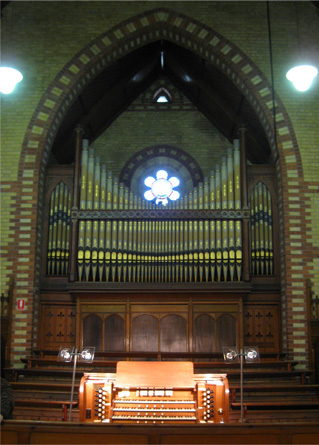
| The T.C. Lewis organ at
St George's, like all organs, is unique. Built in 1882, the T.C Lewis organ,
when it arrived from London, was assembled by George Finchham, the Melbourne organ builder
not the English organ builder T.C. Lewis. The two manual organ with a pedal, cost £1,044 following the appointment of Thomas Brentnall as organist. Records show that
the job number was 344 and that Lewis only used even numbers in his numbering scheme.
However, other records kept by Lewis were lost in the bombing raids over London. T.C Lewis only exported five instruments into Australia. The first of these five instruments was purchased by St John’s Pro-Cathedral, Brisbane in 1873. In 1882 the St Georges pipe organ and in 1886 two other organs were purchased, one in Wesleyan Church, Newcastle and the other for a Congregational Church in Petersham. The largest of the Australian Lewis organs was and is the 49 stop organ of Melbourne’s St Paul’s Cathedral. Along with the organ at St Paul’s Cathedral, St Georges now remains one of two T.C. Lewis organs in Australia. Although there were originally five of these organs, three were destroyed by fire and other disasters. In fact St George's has the earliest surviving Lewis organ in Australia. Subsequently, it has an essential place in Australian Heritage. Possessing some bold and brilliant voices, a common characteristic in Lewis organs, has also earned the organ significance in the National Trust. After some modifications occurred in 1906, the next major work was in 1935 when F. Taylor of Hawthorn installed a tubular-pneumatic action and a third manual, the choir organ. These major modifications cost a total of 604£. Gradually problems in the organ arose however, fortunately the Lewis pipework remained largely unaffected. In 1998 Australian Pipe Organs of Keysborough replaced the tubular-pneumatic action with a electro-pneumatic action. This gives the organ instant sound when the a key is pressed. In addition to this a solid-state switching and coupling system was installed. A general refurbishment and cleaning of pipes was undertaken. All this work cost $80 000, $10 000 of which was provided by Heritage Victoria. The organ was re-opened with a recital by Paul Stubbings, an international organist with the Prix d’Excellence of Amsterdam an award of achievement. The organ of St George's possesses wonderful stops that are a delight to the organist. The acoustic structure of the church also allows the delicate yet powerful sound to resonate. The position of the console also allows the organist to enjoy the music he/she is performing. In many organs, such a luxury is not provided and therefore the musician has to be prepared to anticipate the sound the audience is hearing. The solo voices on the choir organ compensate for the size of the organ. Although the organ cannot be regarded as small, many contemporary pieces require a larger instrument that also posses such voices as the choir organ. And the 4’ Flute on the Great, provides the colour and foundation to many pieces, predominantly in baroque music. |
||||||||||||||||||||||||
The Organists of St George's:
|
||||||||||||||||||||||||
The Choir |
||||||||||||||||||||||||
| Second Sunday Singing is available to those who love to sing and also for experienced choir members. New songs, hymns, and chants for worship are learnt. | ||||||||||||||||||||||||
St George's
Uniting Church
|
